

Unpacking Xenophobia in Latin America from a Postcolonial Perspective
Across Latin America, some foreigners are deemed worthy of sympathy, and some are not, depending on the context, location, and moment. The distinctiveness and ambivalences of such social behaviors have become ever more visible in light of recent migrations, which are widely heterogeneous and escape easy categorization. People moving across borders under constrictions and precariousness—often escaping economic turmoil, political repression, or human rights violations—are commonly subject to social aversion in their new countries. Yet a “migrant” facing prejudice at a given place and moment may not be object of animosity at all elsewhere. At the same time, Latin America continues to be a key destination for foreign entrepreneurs, “lifestyle migrants” and “digital nomads” who generally escape such forms of discrimination—and indeed seem to be widely welcomed due to their perceived economic and social contributions.
Hence, xenophobia—the aversion towards foreigners—seems to be practiced in a selective and ambivalent manner in Latin America, well beyond sheer legal and nominal distinctions between nationals and foreigners. In this respect, scholarship has offered some hints on how, why, and when these forms of discrimination emerge, locating the conversation on xenophobia as mediated by historical ideas about “race,” gender, class, education, and wealth (Bonilla-Silva 2020). Yet, we still lack a comprehensive vocabulary to illustrate the selective and fluid operation of xenophobia in an increasingly mobile region, as well as a comparative empirical ground allowing us to identify better ways to counter the advance of discrimination against migrants and refugees.
Aiming at narrowing these conceptual and empirical gaps, the project Socio-racial Hierarchies and Xenophobia in Latin America started in 2025. We build on the conceptualization of xenophobia as entangled with “socio-racial hierarchies”—structures of social subordination organizing community relations along the category of “race.” We mobilize the overlap between both categories to illustrate how colonially driven beliefs, surrounding what “race” is and what it does, are essential to understanding who is thought of as a more or less desirable foreigner in the region. We understand that this historical continuum is intersected with related structures of class, wealth, gender, education, and ability among others, which play an essential role in configuring different forms of postcolonial imagination about “foreignness.” Through our research, we theorize that such imagination has been essential to configuring contemporary national identities, the social borders of the nation, and to categorizing which persons are worthy—and which are not—of inclusion in such national projects, notably in the example of contemporary migration and refugee policies.
In practice, xenophobia seems to fall hardest on the groups seen as furthest from a country’s unspoken racial ideal, while it is much weaker (or virtually absent at times) towards “desirable” foreigners, who are perceived as closer to that threshold. That ideal, more often than not, is rooted in whiteness, functioning not merely as a phenotypical marker but as a power structure that regulates social interaction across institutional practices, legal frameworks, regional patterns of demographic distribution, and classed, gendered, and ableist schemas of labor differentiation (Ceron-Anaya et al. 2023).
Essential to our research, xenophobia does not work the same way in every location and over every foreign community in the region. Who gets targeted, and how intensely, shifts depending on where, when, and who we look at, as national ideas about foreignness and who counts as un/welcome continue to evolve. In the context of increasingly politicized cross-border migrations, which often challenge postcolonial imagination about who is part of the nation and who is not, context turns out to be substantial for the analysis. We therefore argue that xenophobia is better understood as a relational practice, which can only be fully unpacked when we look at the shifting, fluid, and overlapping ways that foreignness, national belonging, race, gender, class, and ability intersect and interact, along a continuum of postcolonial socio-racial hierarchies in the region. We comment next on the work we have conducted to date in the framework of this ongoing research.
Methodology: Socio-racial Hierarchies and Xenophobia in Six Countries
To ground our analysis, we designed a comparative case study comprising six Latin American countries: Argentina, Brazil, and Mexico, three of the largest and most populous societies; Peru, a key Andean nation; Panama, a major transit point for migrants en route towards (and, more recently, from) the United States; and the Dominican Republic, a key Caribbean nation. Each of these countries has received significant Venezuelan populations over the last decade, amidst the continuous economic and social emergency documented elsewhere (Freier and Doña‐Reveco 2022; Zapata and Tapia Wenderoth 2022; Palma-Gutiérrez 2024). Each is also home to diverse communities from neighboring countries (Bolivians in Argentina, Haitians in the Dominican Republic), populations displaced amidst specific forms of precariousness and violence (Hondurans and Salvadorans in Mexico, Nicaraguans in Panama), or particularly racialized groups within their host communities (Haitians in Brazil). The diversity and richness of these settings proved crucial to our aim of formulating theory grounded in the diverse relational configurations surrounding the overlap between socio-racial hierarchies and xenophobia.
The project began with the configuration of six local research teams, one per country. Co-investigators then conducted a scoping literature review analyzing existing scholarship and institutional texts on national views of xenophobia. Although each review was compiled independently, the six resulting texts followed methodologically aligned aims, mapping the key analytical and conceptual work on how socio-racial hierarchies and xenophobia intersect. These findings directly informed the design of the project’s second stage: a series of focus groups (three per country) with local and migrant communities. Based on our initial approach, we determined that co-investigators in each location would invite a group of locals, a group of Venezuelans, and a third significant group of foreigners to discuss, in small groups, within a safe and secure environment, attitudes, experiences, and beliefs around xenophobia and intersecting structures such as “race,” class, gender, wealth, and other characteristics. The second phase ultimately comprised eighteen focus groups (see Table 1).
Table 1: Location and Distribution of Focus Groups (per participant communities)
|
Argentina |
Argentineans |
Venezuelans |
Bolivians |
|
Brazil |
Brazilians |
Venezuelans |
Haitians |
|
Dominican Republic |
Dominicans |
Venezuelans |
Haitians |
|
Mexico |
Mexicans |
Venezuelans |
Honduran and Salvadoran* |
|
Panama |
Panamanians |
Venezuelans |
Nicaraguans |
|
Peru |
Peruvians |
Venezuelans |
Colombians |
*This focus group comprised persons of two different nationalities who had undergone similar, collective experiences of discrimination and institutional prejudice in Southern Mexico.
One of the study’s key contributions lies in the collective design of these focus groups. Building on prior work by colleagues in Argentina (Cuesta et al. 2023), we defined a participant recruitment protocol attentive to participants’ social and economic characteristics (most were blue-collar or informal workers) while also seeking gender balance. Participants received an honorarium, and informed consent was recorded throughout. Sessions were conducted both virtually and face-to-face, depending on researcher and participant circumstances and preferences. Strict protocols regarding informed consent and anonymization were followed, developed collectively as a set of “good practices” drawn from our prior research experience. Through a series of written and virtual exchanges involving academic reflection among co-investigators across the six countries, we also designed a single focus group instrument, adaptable to each participating location and community. We used a combination of graphic and audiovisual stimuli and prompts to elicit reactions and conversation (see Image 1), aimed at exploring how participants construct meaning while questioning taken-for-granted views and approaches (Frisina 2018). For foreign communities specifically, this analysis was complemented by a set of Likert-scale questions on perceptions of discrimination in their host locations (see Image 2).
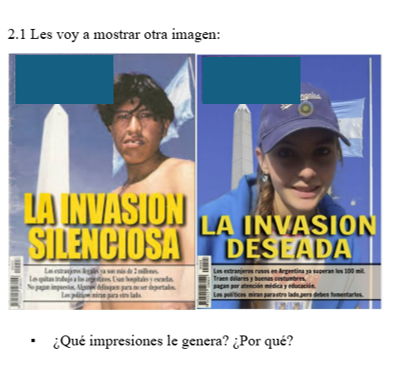
Taken from the focus groups with Venezuelans and Bolivians in Argentina, led by Ana Paula Penchaszadeh and Micaela Cuesta—Publication identifiers blurred in this picture for copyright reasons.
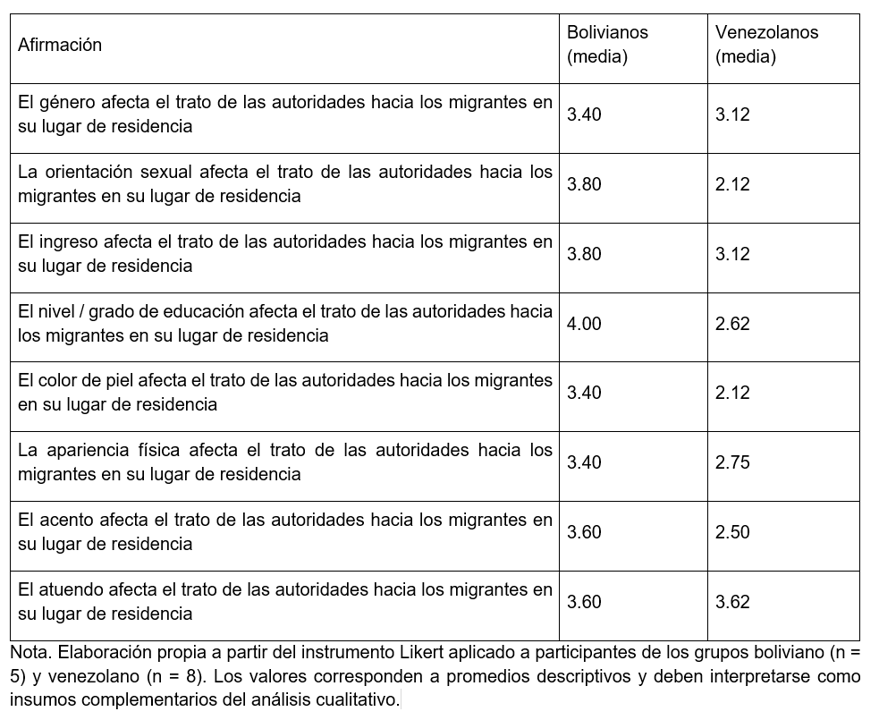
Example of Likert scale exercise in Focus Group with foreign communities. Taken from the focus groups with Venezuelans and Bolivians in Argentina, led by Ana Paula Penchaszadeh and Micaela Cuesta.
Given the contentious nature of the issues addressed, such as discrimination and other forms of structural violence, we established clear ethical rules of engagement and reflected carefully on protocols for the use of information, conversation, and participants and researchers safety. Anticipating that uncomfortable conversations were likely, focus group leads and their teams remained attentive to avoiding re/victimizing assessments, following the principle of no harm in migration research (Stierl 2022). At the time of writing (August 2026), four of the six teams have concluded data collection (Argentina, Dominican Republic, Mexico, and Panama), with the remaining two (Brazil and Peru) expected to finish within the coming weeks. What follows presents preliminary findings from our project based on the experiences of locals and migrants in these first four countries. These ground key theoretical ideas around the overlap between socio-racial hierarchies and xenophobia, and the colonial relational entanglement that appears to operate as a technology of migration control across the region.
Preliminary Findings
Colorism as a key device of social hierarchization among locals and migrants alike
Colorism —the differential valuation of individuals based on the aesthetic perception of bodily and phenotypical difference, with skin color as its primary marker (Dixon and Telles 2017)—functions as a robust and consistent mechanism of social hierarchization across the four countries. Both migrants and locals displayed near-automatic associations linking light skin and ascribed European features with authority, status, wealth, and trustworthiness. In contrast, dark skin and Indigenous or Afro-descendant features were linked to manual labor, informality, or suspicion. In Argentina, participants described socio-racial hierarchies as a rapid, embodied meaning-making device that orders social position through bodies and appearances, rather than as an explicit form of regulation. Conversations with locals and Venezuelans in Panama revealed social preferences for certain bodily and phenotypical attributes based on both perceived cultural exoticism and perceived wealth or social capital. Participants in each country conceptually distinguished “race”—linked to skin color and physical traits—from “ethnicity”—related to group history and ancestry. Yet this distinction did not prevent colorism from functioning as an implicit hierarchy marker in practice. Such processes reveal longstanding regional patterns, as Venezuelan migrants in Panama, Mexico, and the Dominican Republic described analogous racialization processes operating in both origin and destination countries.
“Race” and xenophobia overlap in relational, contextual, and fluid ways
Focus groups with different national communities confirmed that not all migrants are perceived or treated equivalently. A clear hierarchy separates “desired” from “undesired” migration, with race and racialized identity as the primary structuring axis. Importantly, in most focus groups, national origin seemed to matter less than the interlocking combination of race, phenotype, and perceived economic means. White, European, North American, or visibly wealthy migrants were welcomed and celebrated, while Black, Indigenous, poor, or unauthorized migrants were often subject to suspicion and discriminatory institutional treatment. This asymmetry was starkly visible in experiences and perceptions surrounding Haitian migrants in Mexico and the Dominican Republic, and Nicaraguan migrants in Panama. In Argentina, participants across groups explicitly linked perceived whiteness to socioeconomic value, invoking discourses of “civilization.” Notably, poverty itself was described as racialized by migrants as well as locals, following a long-documented postcolonial pattern (Sivanandan 2001). In Panama, participants described police checkpoints disproportionately targeting dark-skinned individuals, while light-skinned people passed unchecked. Discussing recent migration across the Darién rainforest, local and migrant participants noted that identification documents were demanded more frequently from poorer, darker-skinned individuals, while better-dressed, white-presenting people passed unchallenged at times, illustrating how racialized appearance, filtered through class markers, shapes everyday exposure to border control and surveillance.
Venezuelan migrants as a paradigm of xenophobia's fluidity and relationality
The Venezuelan case illustrates the fluid, relational character of xenophobia, since Venezuelans occupy an intermediate, ambivalent position. While most experience real discrimination, many simultaneously recognize comparative privilege relative to other racialized groups. This dual positioning reveals xenophobia as a relational system ranking migrant groups against one another, rather than a binary national/foreign relation. At times, such patterns seem to displace discrimination onto other groups instead of producing automatic migrant solidarity, closely tied to pre-existing regional socio-racial hierarchies. Across the four countries, Venezuelans reported police profiling, housing difficulties, professional devaluation, and slow, costly regularization. Yet in the Dominican Republic and Panama, Venezuelan participants acknowledged, and at times emphasized, receiving better treatment than Haitians or Nicaraguans, both from institutions and from local communities more broadly. In Mexico, Venezuelan participants perceived discrimination as directed more intensely toward Black individuals, positioning themselves outside that axis. In the Dominican Republic, Venezuelans described considerate institutional treatment while observing darker-skinned Haitian migrants treated with suspicion and harshness across shared institutional and public spaces. Some participants explained that racial discrimination and class markers jointly determine this placement along a continuum of tolerated versus rejected difference.
Xenophobia as a colonially-rooted technology of migration control
Xenophobia operates not as diffuse prejudice but as an active technology of migration control, selectively discriminating against those perceived as distant from a racialized national ideal. Regularization procedures, though presented as neutral, function as mechanisms of racialized exclusion. Testimonies about costs, delays, and bureaucratic paperwork revealed how these disproportionately burden the poorest and most racialized populations across the countries explored. This exclusion is sustained through everyday, normalized practices across recurring institutional spaces—such as transport, checkpoints, housing, health, schools, social media—rather than through isolated incidents. A Venezuelan participant in Panama described regularization procedures reaching US$5,000 and waits exceeding two years, contrasting with facilitated residence paths available almost exclusively to wealthy, Western foreigners. In Mexico, participants from Honduras and El Salvador described how protracted asylum processes force migrants into precarious, exhausting living conditions. The foreignization of Indigenous communities was also discussed. Mexican participants of Indigenous origin reported being compelled to prove nationality on routes between Chiapas and central Mexico. Moreover, a Venezuelan participant in Panama noted that money mitigates racism, easing entry, paperwork, and institutional friction. Other participants distinguished the valorized category “foreigner” from the stigmatized “migrant,” the latter carrying negative connotation regardless of actual nationality. In the Dominican Republic, xenophobia often assumed administrative or economic justification while remaining articulated through historical prejudice toward Haitians. “Haitianidad” seems to function there as a racialized category exceeding formal nationality, such that those merely read as Haitian face discrimination alongside Haitian nationals.
Agency, political subjectivity, and the navigation of racialized hierarchies and xenophobia
Despite these institutionalized harms, locals and migrants revealed that they are not passive recipients of racialized hierarchies but active agents who navigate, contest, and reconfigure them, producing collective identities, affective solidarity, and critical reflexivity out of shared histories of marginalization. In Argentina, Bolivian participants articulated a more politicized experience of racialization, appropriating “us” as a migrant, brown-skinned, Indigenous collective. In Mexico, one participant described her partnership with a Central American migrant, illustrating transnational affective networks bridging migrant and local populations. In Panama, participants critically contested the analytical validity of “race” versus “ethnicity” and challenged the national mythology of the “crisol de razas” (racial melting pot) as fiction. In Mexico, indigeneity emerged as contested terrain. While one local participant equated it with ignorance, several others proudly self-identified as Maya-Tsotsil, revealing racialized categories as actively negotiated rather than passively endured, complicating any purely unagentic account of racialization, discrimination, and xenophobia.
The Future
These early findings are only the introduction to a range of academic and outreach outputs we have designed as a research team. Our first conceptual journal article has recently been submitted for review to a major interdisciplinary journal. We have also begun the preparation of a comparative edited collective volume, commenting on the findings and analyzing the experiences with the focus groups in each of the six national locations included in the study. We also aim to be present at LASA 2027—Navegar el colapso: reinventar la política, cuidar lo común—in Mexico City with a roundtable attended by most researchers to further comment on the findings of this project. We are truly convinced that the outset of this view on xenophobia and socio-racial hierarchies in Latin America as a relational entanglement constitutes a valuable conceptual and empirical contribution for researchers and practitioners committed to countering discrimination and racism against migrants, refugees, and broader communities in our region. We are deeply indebted to Ford-LASA for their support through their Special Grant scheme, which made this research possible.
The project’s national current and past co-investigators are: Argentina: Ana Paula Penchaszadeh, Micaela Cuesta, Joanna Sander, Verónica Asurey & Mora Cácharo. Brazil: Gisela P. Zapata & Ali M Arrieta Arrieta. Dominican Republic: Jenifer Vanderhorst, Desiree del Rosario Sosa & Santiago Gallur. Mexico: María José Sánchez García, Riger Mejía & Hiram Angel. Panama: Eugenia Rodríguez, Maria Teresa Torrez & Saniya Karimova. Peru: Nancy Arellano & María Angélica Fernández.