

¿Cuál es tu maricada con la belleza? [laughs]
The entry point
My thesis was born in a hair salon. Azul Romero, a non-binary member of the Miss Nancy Land Organisation for Afro-Caribbean Women and Young Islanders, took me on their motorcycle to visit Mary Luz Ardila, the first transwoman to open a beauty salon in the San Andrés Archipelago. This archipelago is a department of Colombia located in the western Caribbean. We laughed together while we chatted, as all the transwomen I met asked me: ¿Cuál es tu maricada con la belleza? [laughs]. The laughter made it sound like we knew what we were talking about. The making of maricada was the making of beauty. In other words, “You can do many maricadas with beauty,” they said. Although I might suggest a literal translation of maricada as faggotry, queerness, or transness, as much of Anglophone scholarship does (see a previous critique on the matter, among others, in Espinosa 2015; Ghisyawan 2015; Lorde 1982; Wekker 2006), maricada goes far beyond this. For transwomen, who are insultingly called ‘maricas’ by others and proudly refer to themselves as “maras,” maricada implies the very concrete actions of communitarian intervention to deal with social contempt. These layered and often conflictual practices of community-building are the object of my thesis.
Based on community and ethnographic work with the gender, territorial, and ethno-racial rights organization Miss Nancy Land Organization, a collection of encounters with the maras throughout 2022 and 2023 evolved into an investigation of social contempt and the use of beauty. They invited me to document their stories by accompanying them in their homes, hair salons, shows, spectacles, and beauty pageants. We laughed at these encounters because their community intervention with maricada has not simply been about gender and sexual identities. Instead, it has involved a series of ongoing dissident and contradictory strategies— using beauty-related activities in which they have been historically marginalized—to survive, get on, remain in the archipelago and negotiate their community belonging.
Colombia, the land of beauty, was the slogan of the tourism promotion campaign launched by the country’s centre-left government just as I began my field research in 2022. However, what kind of “beauty” does it refer to? Should we accept the argument that Colombia serves merely as the backdrop for Beasts and Beauty, as previously suggested with a high degree of caricature, gender binarism, and transmisogyny (Stanfield 2013), which Moreno Figueroa (2015, 199) has criticized as an understanding that takes beauty to be an “uncivilized, unimportant, unserious realm?”
The portrayal of Colombia through the figure of the Beasts—as an institutionally violent and virile entity—led to the idea that “the dysfunction of Colombia is gendered male” (Stanfield 2017, para. 10). Stanfield ultimately supports an ableist, cisheteronormative view rooted in the white-mestizo elite, claiming that cismen personify the nation, backed by government institutions. This assumption creates a problematic national caricature when he states that beauty acts as a feminine “sedative” for a nation long affected by violent conflict, asserting that “in a world full of so many institutionalized beasts, beauty represents the feminine, life-giving, peaceful, and functional essence all crave but few enjoy” (Stanfield 2017, para. 10).
A critical feminist intervention has moved beyond the dichotomy of understanding beauty as either an instrument of oppression or resistance by focusing on “the processes of beauty (what beauty does) rather than the contents of beauty (what beauty is)” (Moreno Figueroa 2013, 140). This feminist critique, based on what beauty does through the logics of racialization of ciswomen from the middle classes in Mexico, who are seldom heard in studies about beauty, has served as a starting point.
However, our understanding of what beauty does in the lives of transwomen remains limited, as does our knowledge of what they actively do through beauty and with beauty. The critical task is of major importance as it means intervening into beauty studies from the perspective of non-hegemonic beauties in an archipelago marginalized ever since Colombia’s founding. To put it simply, how do transwomen and maras intervene in their community bonds by engaging, even in contradictory ways, with a politics of beauty? Why are they using beauty and beauty-related practices to cope with social contempt in the Caribbean? What can we learn about communal lifestyles through their engagement with beauty? Moreover, what makes the use of beauty political?
Figure 1. Map of San Andrés, Old Providence, and Ketlina.
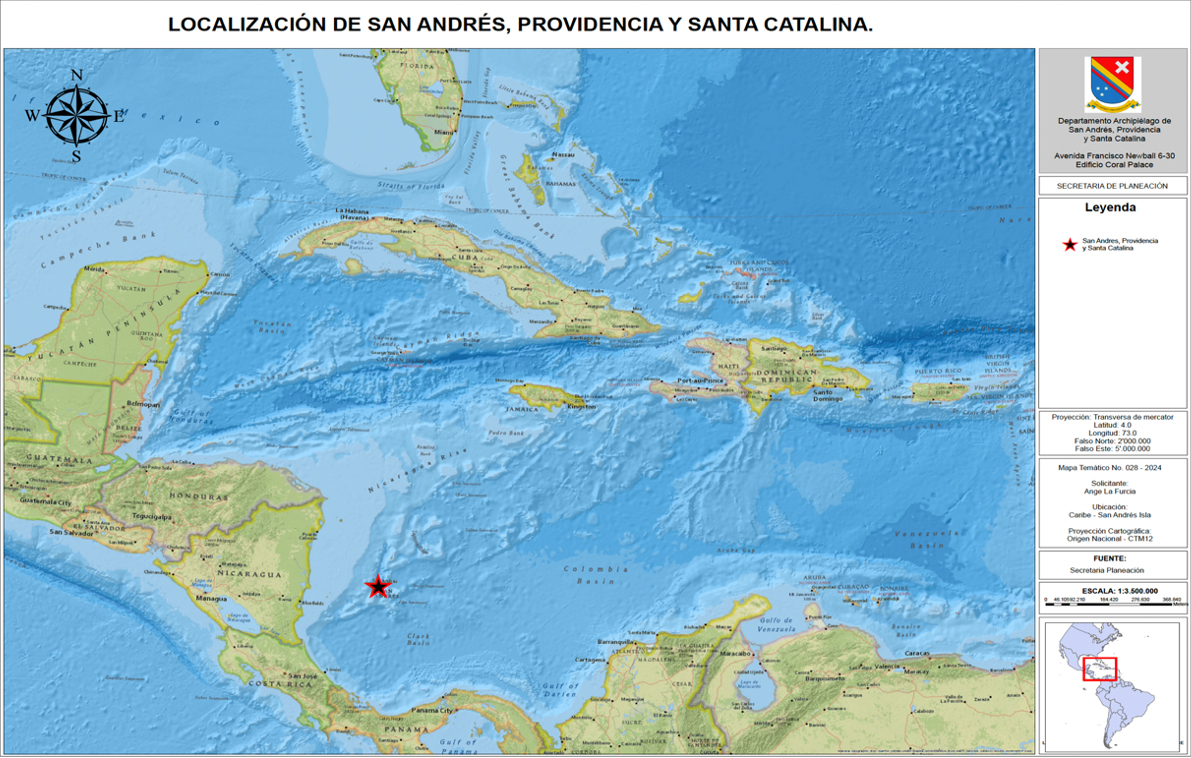
Source: Planning Secretary of the San Andrés Archipelago Department, 2024.
Through community work and in each encounter with transwomen or maras, they reveal non-hegemonic or marginal ways of engaging with beauty, which is why this Caribbean context forms in-depth studies. My thesis proposes a sociological study of the politics of trans beauty in the Colombian western Caribbean. In particular, it analyzes how the involvement of transwomen or maras in beauty occupations helps them cope with social contempt. The fieldwork focused on the Archipelago of San Andrés, Old Providence, and Ketlina, which Britain colonized in the seventeenth century and which has been administratively and politically incorporated into Colombia since the nineteenth century (Figure 1). The Raizals, an Anglo-Afro-Caribbean ethnic group, inhabit the territory protected by Colombia’s multicultural Political Constitution of 1991. Religiously, they are predominantly Protestant and speak Creole (Kríol), English, or Spanish.
Transwomen or maras have frequently worked in beauty-related activities and come from working-class and rural backgrounds, often from lower social strata. Previous transfeminist studies have shown that they are disproportionately represented in these occupations, which they alternate with sex work as ways of constructing feminine gender identities and earning a living in the face of cisheteronormative violence and the challenge of economic survival (Bello 2018; Posso and La Furcia 2016; Reyes and Urrea 2015; Urrea and La Furcia 2014). This trend became particularly prominent with the expansion of the hotel and tourism industry in the 1950s, when the region was established as a Free Port. Concurrent with this trend, there is a link between beauty-related activities and communitarian and cultural festivities that celebrate beauty queens as representatives of the islands. The celebrations commemorate the Colombianization process that began in 1822 when the archipelago was incorporated into the Constitution of Cúcuta (Crawford 2009; de Albuquerque and Stinner 1978; Parsons 1956).
As part of the Colombian State, the archipelago is protected by the multicultural Constitution of 1991, which grants its inhabitants ethno-racial recognition and territorial legal rights. The region was a British Puritan colony in the seventeenth century. In the early nineteenth century, after being under Spanish rule, it was incorporated into the newly created republic of Gran Colombia following the independence movement. Over 60% of the islander population is of Black and Anglo-Afro-Caribbean descent (DANE 2020a). According to revised projections and government data, the National Administrative Department of Statistics, DANE (2009, 2020b) reported around 70,000 inhabitants on the islands. Of these, 30,565 people self-identified as Raizals, accounting for 0.07% of Colombia’s total population.
Transwomen or maras actively continued to promote their life paths and rights, participating in beauty salons, pageants, and festivals, throughout the shift towards multicultural institutionalization. In this context, they continued to develop their beauty-related activities alongside the expansion of LGBTI policies—the acronym was originally used in legal and institutional programs, based on Colombia’s Political Constitution.
However, transwomen’s personal journeys and collective initiatives conflicted with the persistent legacies of cisheteronormative violence, colonial respectability tied to Protestant religious values, ethno-racial struggles among islanders and mainlanders, and economic survival. In response to these intersecting socio-historical challenges, this study argues that transwomen or maras have carved out their own space and devised individual strategies alongside communitarian interventions to uphold their dignity through beauty-related activities.
Transwomen or maras continue engaging in individual and community-based work to navigate experiences of individuality and belonging within the archipelago community. These experiences involve using beauty as a communal and contradictory strategy, a resource, and an arena for individuality, community involvement, and politicization amid multicultural public policies, care work, legacies of colonialism, and corruption. The key question behind the experiences of transwomen in beauty occupations is how their participation in these communitarian activities and the bonds they develop explain how they deal with social contempt in the Caribbean.
My thesis, therefore, arises from a sense of discontent, dissent, and nonconformity with current interpretations and assumptions regarding the involvement of transwomen in the world of beauty. It is not new to observe that stereotypes and prejudices assume that engagement with beauty is solely concerned with vanity, consumerism, and physical appearance, and that this is what explains gender oppression (among others, see Lasch 1979; Lipovetsky 1983; Stanfield 2013). In this line, for example, it has been argued since the foundational analysis of beauty work that femininity involves constructing and shaping the body to be surveilled and normalized (Bartky 1997; Young 1980).
The reason for this foundational approach is that the body has been a central focus in studies examining gender practices and engagement with beauty (see, among other critical accounts, Jarrín 2017; Vartabedian 2024). In fact, the literature on the relationship between the body and transwomen is as longstanding as discussions about the subject within the context of the Eurocentric pathologization of trans identities in the nineteenth century (for a critical review of early analyses of this narrative, see, among others, Beaubatie 2016; Espineira and Thomas 2022; Stryker 2008; Stryker and Whittle 2006). The making of the body has been a topic of discussion within operating theaters, hormone therapies, and endocrinological processes.
Contemporary intersectional feminist critiques have begun to deconstruct the assumption that transwomen’s lives are only concerned with gendered beauty practices for vanity or individual consumerism (among others, see Araújo dos Passos and García 2024; Bello 2018; Berkins 2003; Dumaresq 2013; Gomes de Jesus 2014; García 2018; Nascimento 2021; Ochoa 2014; Reyes and Urrea 2015; Urrea and La Furcia 2014). However, these critical interventions above inevitably begin with an approach to the construction of the trans identity, the body, and its surface limits and possibilities. Although beauty has been discussed in relation to the body, the body is not necessarily the sole focus of the use of beauty, and the issue for transwomen is not necessarily using their bodies to construct a gender identity aimed at beautification. In other words, as maras said, “You can do many maricadas with beauty.”
So, what other responses can be offered if we listen to and address the different themes that transwomen or maras evoke when they talk about their use of beauty? What different approach must be proposed by reviewing the practical ways transwomen use beauty? To do so, I engaged in community work with them for a year and a half, gradually listening and beginning to write about what they do and claim with beauty in an archipelagic territory that has struggled to be integrated into Colombia, the country of beauty. This fieldwork, conducted through prior negotiations based on informed consent, recording of field notes and audio, and following the transwomen or maras in their beauty pageants, homes, and salons, has helped to take seriously the deconstruction of an understanding of beauty as “superfluous, ‘wrong,’ and/or only a source of pain” (Moreno Figueroa and Rivers-Moore 2013, 134).
To reconceptualize the use of beauty by transwomen or maras, it is also necessary to adopt a critical take on the wider social structures and community bonds of the Caribbean. The task follows a process of reflection after dedicating time to writing about transwomen’s claims on maricada through beauty. An important step in this was reviewing a renowned ethnography on the islands by British anthropologist Peter Wilson, Crab Antics. A Caribbean Case Study of the Conflict Between Reputation and Respectability, which was published in English in 1973 and in Spanish in 2004 as Las Travesuras del Cangrejo.
Wilson’s study, an ethnohistorical account of islander society in the 1950s and 1960s, draws on his thesis supervisor, anthropologist Sidney Mintz, to highlight “the importance of informal grouping lacking any institutional articulation” (Wilson 1973, 2). His account introduced an approach to sociability against the understanding of a totalized, homogeneous and standardized space in the Caribbean. Following his claims, community bonds in the archipelago have formed since emancipation through a defense of self-determination, facilitated by communitarian engagement, which sustains close-knit circles of friendships, community-church-based activities, cultural festivities, and a shared sense of belonging to the same environment and place. Islanders’ identities are not derived solely from their position within major institutions, primarily the family and household, nor from the formation of the new centralized Colombian state.
The task of understanding transwomen’s claims through beauty in the San Andrés Archipelago takes place specifically within this former British Puritan colony, where Crab Antics’ ethnography remains a mandatory reference in local Caribbean studies. Although Wilson’s model was previously used and criticized outside the islands for its cisheteronormative and sexualized portrayal of religion in the Caribbean (among others, see Agard-Jones 2009; Kempadoo 2004; Thomas 2004; Solano 2014a), these feminist contributions have not necessarily resulted in an ongoing critical dialogue from a sexual dissident and gender-non-conforming perspective.
The core of a more pluralistic perspective on how transwomen foster experiences of individuality within community bonds stems from a critical effort that considers the formation of informal groups linked to a sense of community belonging, dating back to emancipation rather than solely relying on strong institutional attachments. This sense of community-building lies at the heart of transwomen or maras’ interventions through beauty-related activities. It traces back to the period following emancipation in the mid-nineteenth century, before the introduction of multicultural institutionalization based on the Political Constitution of Colombia, which recognizes gender, ethno-racial, and territorial rights.
To address this feeling of unease about what transwomen do with beauty-related activities, the thesis enriches analyses of communal forms of individuality (i.e., individual affirmation rooted in communitarian accountability) by following the claim of the politics of beauty. In doing so, it contributes to four research agendas.
First, I engage with an understanding of community-building in beauty politics. I depart from a critical account on institutional socio-historical perspectives that view islanders as secondary and derivative of group structures or positions in Caribbean societies, which was criticized early on by Wilson’s ethnography (1969, 1973). However, I question his cisheteronormative model based on the moral values of colonial respectability by emphasizing maras’s individual and collective sense of belonging.
Second, I contribute to the sociopolitical understanding of beauty. The literature on beauty politics and transwomen’s lives has focused on the dichotomy of oppression and resistance (see, among these critics, Jarrín 2017; Vartabedian 2024). Instead, I show how transwomen navigate intersections of race, class, ethnicity, territory, gender, sexuality, and generational cycles in their beauty-related practices to foster community bonds and affirm their individuality.
Third, I distance myself from approaches that suggest neoliberal currents are the sole or primary direct cause of engagement with beauty (Lasch 1979; Lipovetsky 1983; Preciado 2008). Neither individual creativity is solely a result of consumerist trends nor is involvement with beauty simply a matter of vanity—rather, transwomen’s creativity resorts to beauty practices and communitarian responsibility.
Finally, I contribute to feminist and sociological scholarship, which has recently highlighted how, through beauty care, Black ciswomen in Colombia have gained “the right to assert the individuality and uniqueness they had been denied for being members of a dominated group” (Viveros and Ruette-Orihuela 2021, 121). However, my thesis emphasizes beauty in work and daily life, drawing on the experiences of working-class Caribbean transwomen. To do so, I explore alternative ways of producing individuality as an individual assertion rooted in collective belonging and community bonds.
Beauty politics refers to how beauty does something to transwomen or maras’ sense of belonging within the islander community, which also discriminates against and abuses them. To confront social contempt, transwomen’s efforts involve a variety of actions and experiences to carve out a path in the Colombian western Caribbean, assert themselves, and reaffirm their bonds to the archipelago community through beauty. This is what I refer to as Sea Antics.
Methodology: the ‘ethnography of the hunch’ based on community work
Azul invited me to explore a series of Sea Antics in beauty salons, pageants, and cultural festivals. I conducted an in-depth ethnographic study of beauty by visiting transwomen or maras’ workplaces and homes, based on qualitative research carried out during community fieldwork on the archipelago from February 2022 to September 2023. I have used the expression of an “ethnography of the hunch” to give meaning to the “hunch” I gained through engaging with the activities of the Miss Nancy Land Organisation. This ethnography of the “hunch” (etnografía de la corazonada) signifies the complex and delicate relationship between living together and individual life paths in the world of beauty, viewed from the situated perspective of transwomen or maras.
When I use an “ethnography of the hunch,” I am referring to how Sidney Mintz describes Wilson’s test of his “hunches” regarding the organization of social life in Caribbean societies, particularly in the English-speaking islands, as mentioned in the prologue to his Crab Antics:
Hunches, of course, are supposed to be predictive as well as intuitive, and the author is not so much predicting here as inferring. But his inferences aim at making sense of a wide variety of data that do not seem to him otherwise to lend themselves to elegant summation. (Mintz in Wilson 1973, xi)
In my case, I had the “hunch” to emphasize transwomen’s life paths beyond the construction of gender identity, but through community accountability via their involvement in beauty-related activities. I started by going via the Miss Nancy Land Organisation, with spontaneous meetings with Azul, beginning with Mary Luz—the first transwoman migrant to arrive on the archipelago and open a beauty salon—and Normi Pusey Pomare, the acclaimed trans beauty queen coach and descendant of enslaved people in San Andrés. By following their guidance, especially with Normi as my mentor, I joined beauty pageant training as an amateur beauty queen. I then collected the stories of nearly all the transwomen they knew or had met through community work based on workshops on gender, sexuality, and LGBTI public policies. I documented the life stories of 33 maras.
My account of the ethnography of the hunch differs from anthropological urban ethnographies in Colombia (García 2018) in that it does not involve an intimate and simultaneous narrative about gender transition experiences with research collaborators. I refer to my interlocutors as research collaborators because, as previously mentioned, the fieldwork was conducted within the community work. In other words, this thesis is not an ethnographic study whose trans author writes about their gender-affirming journey with their participants. Instead, my approach enhances an empirical and analytical understanding of the deep relationship between transwomen’s self-care and the aesthetics of communal life through my fieldwork notebook: the gossip-graphics of beauty (las chismografías de la belleza). I used this notebook as a fieldwork technique, based on an analytical approach that considers the interpretation of community bonds within the archipelago. Specifically, it explores how I record the interconnection of territory, belonging, individual creativity, mutual support, and care claimed and mobilized by transwomen through gossip in beauty salons, pageants, and festivities.
This study combines various data collection strategies, including over 150 records of in-depth interviews, notes from community work, documentary analyses, and in situ observations. The research also gathers legal policies, television programs and press materials. The long-term ethnography involves beauty salons and contests, LGBTI events, and local celebrations. Drawing on my involvement with beauty queens and hairstylists in the archipelago, facilitated by my engagement in pageantry and community work, I document the contexts and underscore the ways they learnt and developed their practical skills and communitarian claims through beauty.
Roadmap
My thesis is not a conventional monograph. Instead, the body of this research comprises four standalone articles. As the fieldwork revealed that the use of beauty is political in different ways, I explore four dimensions: religion; aging and emotional labor; the creation of community bonds clashing with multicultural policies; and corruption. Some information may seem repetitive, but within this article-based format, my aim is to maintain coherence throughout the in-depth study presented in each article.
In the first article, I move beyond identitarian perspectives on gender to explore the relationship between the use of beauty within the context of Protestant religion. Transwomen or maras use beauty as a contradictory communal strategy for negotiating a sense of belonging to the Black Creole Caribbean. For these transwomen, beauty pageants help to personalize religious values and Christian faith, while also preserving family and friendships, which support them against cisheteronormative violence.
The second article highlights the emergence and consolidation of transwomen migrants’ beauty care work as they age. Family support, especially from mothers, within the domestic economy is vital for developing skills in financial and emotional solvency to survive economically and navigate conflicted loving relationships with cismen. Given the face of crisis and trauma which induced migration, transwomen reconstruct their aging trajectories based on self-preservation rather than on bodily beautification.
The third article presents the claims of dignity made by transwomen or maras, both Raizals and descendants of mainlanders. I emphasize how they use a political assertion of maricada in beauty-related activities, which conflicts with contemporary LGBTI, gender, and ethno-racial policies supported by the Colombian state. This political assertion is at the heart of their individuality in the archipelago community beyond multicultural institutionalization.
Finally, the fourth article explains how beauty serves as a political arena for disputes over profits from private appropriation of public funds using fraudulent beauty-related contracts. I examine a corruption scandal akin to a telenovela (soap opera) of politicization in the deployment of LGBTI policies within clientelist networks. Beauty politics is more than a symbolic resource. It is the terrain where the aesthetics of corruption are produced through conflicts over the private appropriation of public funds and the sociopolitical uses of rudeness (groserías) to destabilize social asymmetries.
This Sea Antics thesis proposes four standalone articles that contribute to Caribbean feminist research at the intersection of beauty studies. I aim to highlight more than what beauty does in transwomen’s lives—rather, what they actually do with beauty and how they engage with beauty-related activities. Transwomen or maras have actively used beauty practices creatively to intervene in community-building.
Read the open-access thesis: Sea Antics: The Politics of Beauty and Transwomen in the Colombian Western Caribbean