

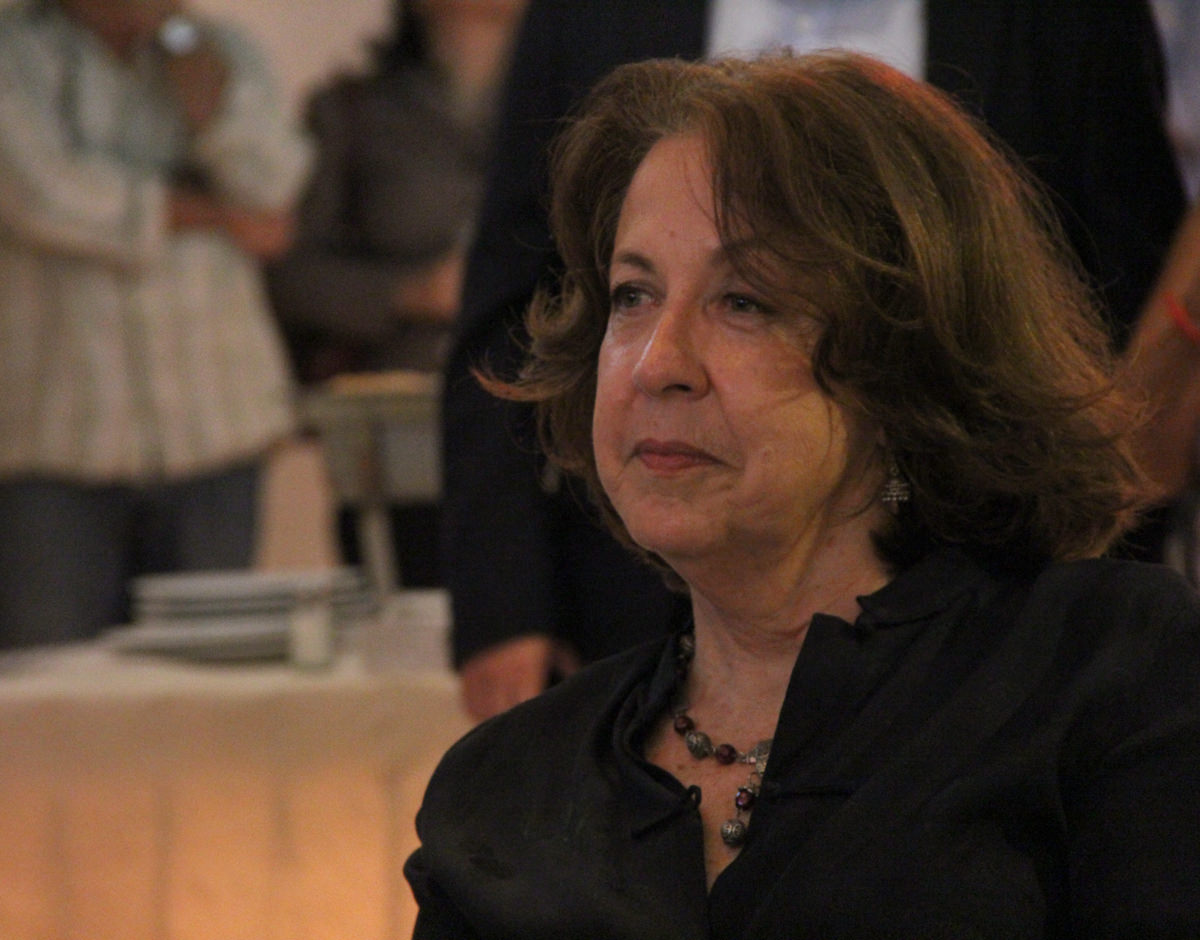
From an early age, Deborah chose to immerse herself in a world defined by a tight iterative trinity: deep ethical-political convictions, rigorous analytical reflection, strategic action and assessment of the consequences, and then back around again. Although never holding an academic position, she became one of our most revered analysts of political and environmental processes in Central America and Mexico, bridging the revolutionary era of the 70s and 80s with the neoliberal onslaught that followed. Although Deborah was never a LASA member, LASA has always thrived on the presence of intellectuals like Deborah, whose approach to the social purpose of scholarly work challenges and inspires the Association’s academy-based members. Her distinctive practice of this ethos included a deep commitment to multiple communities of fellow-travelers—especially intellectuals and practitioners based in Mexico and Central America—many of whom became her dear friends and affirmed those ties abundantly. These reflections—by one of those friends and fellow-travelers—are meant to encourage a moment of pause, to reflect quietly on her proyecto de vida.
After finishing college in 1981—a time that today feels inconceivably distant—I went to Nicaragua to join the revolution. Right away, I sought out Deborah, who already had an ample reputation as a political insider; at first, she was not interested in making time for advice to yet another young “internationalist,” with unknown commitments, skills, and staying power. Educated at UC Berkeley and CIESAS DF, Deborah had a sound academic training, and since the mid-1970s had formed part of the trusted inner-circle of the Frente Sandinista de Liberación Nacional (FSLN). After the FSLN’s triumph in July 1979, she began work with the office of Agrarian Reform, and by 1981, moved to the Planning Ministry, led by comandante “Modesto” (Henry Ruiz). Thanks to her loyalty to Charlie Roberts, a mutual friend who vouched for me, she eventually received me at her home near Siete Sur. Gradually, we became compañeros—in the spirit of the best values of the Sandinista revolution.
By early 1982, Reagan administration plans to attack Nicaragua had begun—still covert but unmistakably enabled by the CIA—and US citizens living in Nicaragua organized in protest. Deborah had started to attend those meetings, and helped to hatch a plan to send a tour of US citizens back to the US to give testimony—of bridges mysteriously blown up, cross-border contra attacks from Honduras, psychological warfare, and the like—in hopes of encouraging greater opposition from within. The group chose three of their most wholesome-looking members—Pat Hines (a Maryknoll sister and widowed mother of four), Peter Shiras (director of Catholic Relief Services), and Charlie Hale (young Harvard graduate from Iowa). Deborah—an experienced political operative—somehow ended up as the fourth member of the delegation; much later, we chuckled about what I came to understand as her assigned role as political chaperon to the three neophytes. That experience—20 cities in 20 days—galvanized our friendship and deepened immensely my respect for her analytical and strategic acumen. The four of us also laughed a lot. A voracious reader, with a keen eye for social transformations on the horizon, at that time Deborah was deeply immersed in a book titled Micro Millennium; she would summarize the argument with great enthusiasm, insisting that something “really big” was coming (it would later be called the internet); the three of us made fun of her.
In 1984 Deborah left the state and helped to found CRIES (Centro Regional de Investigación Economica y Social), led by Xabier Gorostiaga, the iconic Jesuit Priest and influential regional analyst of the Central American crisis. Deborah commented at the time, and again years later, that the CRIES helped immensely to shape and sharpen her lifelong aspirations of research that informs political action. CRIES documented the regional character of US aggression toward Central America—ample funding for repressive militaries, support for anemic governmental reforms to fend off militancy, low-intensity warfare against the Left—and argued with prescience for the need to develop a regional political strategy.
In 1990, Deborah and her lifelong companion Baltazar Lopez moved to El Salvador, with their daughter Gabriela, just after the FMLN’s “ofensiva final” of 1989. Within a few years, she had co-founded the Programa Regional de Investigación sobre Desarrollo y Medio Ambiente (PRISMA), which grew to become the leading “thought and action” center for regional environmental justice in Central America. Long after she left El Salvador, Deborah stayed involved with PRISMA as a senior adviser; as a PRISMA board member myself in the early aughts, I observed the enormous respect Central American colleagues had for her, and the skillful balance she always managed to strike: providing essential guidance, while opening space for new leadership to emerge, and for the organization to flourish independently.
Deborah’s experience with PRISMA strengthened her credentials to be named as the Ford Foundation’s regional (Mexico and Central America) program officer for environment and development (1998-2005). Her commitment to the “trinity” continued throughout this period, as she deepened her engagement with Black and Indigenous struggles for territorial rights, the convergence of environmental stewardship with economic justice, and the key contributions of community forestry, which eventually gave rise to her co-edited volume, The Community Forests of Mexico: Managing for Sustainable Landscapes. (PRISMA published a full list of her publications and her professional profile.) I participated in a research collective in those years that received support from her Ford portfolio, and in characteristically energetic fashion, Deborah got involved, both to learn and to contribute. For three years, we worked closely with her on research in support of Black and Indigenous struggles for rights and empowerment in Guatemala, Honduras, and Nicaragua. She always asked the hard—sometimes uncomfortably hard—questions; yet her integrity and her ability to forge deep connections dissolved what might otherwise have been mild irritation at these “cut to the bone” interventions. A deep mutual trust, grounded in shared past and future political horizons, always carried the day.
Although Balta and Deborah settled in DC after she left Ford and joined a vibrant transnational Latin American community there, the US was not for them. Deborah worked for CIFOR and Rights and Resources International, deepening her expertise in territorial rights, water management, community forestry, and regenerative agriculture. But from the start, it was clear that they would be heading “home” to Latin America, first to El Salvador in 2010, and then to Oaxaca. I had the enormous gift of our paths converging once again—this time in Oaxaca—which allowed me to appreciate up close Deborah’s transition to one of the most active “retirements” I will ever know. She served as consultant and adviser to an array of organizations—both local and international; she continued to read voraciously and widely; she supported ejido cultural and governance activities in San Agustin Etla; and she began to write fiction, based on her Nicaragua years, as a means to reflect on the inspiration and terrible denouement of the Sandinista revolution. Balta and Deborah opened their beautiful home to a constant flow of comidas and convenings, nurturing their communities with gusto and love.
Francisco Gonzalez, a young Oaxacan agroecologist friend and colleague, got to know Deborah in those final years, because she served on the consejo asesor of the Grupo Autónomo para la Investigación Ambiental (GAIA), where he worked. He described to me, with mild awe, her role in board meetings: a consistent ability to identify shortcomings and strategic opportunities with surgical precision; when she spoke, everyone listened intently to learn from her insights. Deborah was relentlessly analytical; her analysis was always tethered to an impassioned indignation with injustice and a deep loyalty to the communities that she nurtured. These communities, in turn, showed an extraordinary outpouring of love, support, and accompaniment in the final months, when illness overwhelmed her body. To her last breath, Deborah’s mind stayed acute, her intellectual curiosity unbound. Through these final months, she would pepper me (and I assume many others) with must-read books and articles, podcasts, and commentary, along with deep affirmations of our 40-year friendship.
May memories of Deborah’s proyecto de vida live on to challenge, inspire and guide us, especially as we grapple with political despair. I can hear our beloved guerrera de amor responding to discouragement with a warm, determined smile: “Let’s do the best analysis we can muster, discuss it amply, and get to work.”